
Buying a home in Burleson Texas, or the surrounding Johnson and Tarrant County communities is undeniably one of the most significant financial investments an individual will make in their lifetime. When navigating the local real estate purchasing process, buyers are routinely advised to secure a standard home inspection. This traditional walkthrough meticulously covers structural integrity, electrical panels, roofing conditions, HVAC performance, and superficial cosmetic issues. However, an alarming majority of homebuyers remain entirely unaware that a standard home inspection stops abruptly at the foundation line. What lies buried beneath the ground—specifically, the lateral sewer line connecting the home to the municipal sewer main or private septic system—is completely omitted.
The consequence of this oversight can be catastrophic. A residential property in the local market may boast flawless quartz countertops, fresh siding, and a pristine roof, while simultaneously hiding a compromised, collapsed, or root-strangled sewer main just a few feet below the front lawn. Even newer built homes can have issues.
Because sewer systems operate entirely out of sight, catastrophic failures can brew silently for years before manifesting as a hazardous, high-cost backup. This comprehensive guide details why commissioning a specialized plumbing sewer scope inspection prior to closing is an absolute necessity for Burleson area buyers, detailing the technical mechanics, financial implications, and strategic negotiation leverage it offers.
Understanding the Sewer Scope: The Technology and Process
A professional plumbing sewer inspection, frequently referred to as a "sewer scope," is a highly specialized diagnostic procedure. It utilizes a high-definition, waterproof, flexible fiber-optic camera attached to a rigid, push-rod cable system. A licensed plumbing technician introduces this camera directly into the home’s primary drain system—typically through an exterior cleanout tee, or occasionally by temporarily removing a toilet or accessing a rooftop vent stack.
As the camera travels downstream through the lateral line toward the city connection, it transmits real-time, high-definition video data to a monitor operated by the technician. Modern sewer scope equipment is also outfitted with a signal-emitting sonde located at the camera tip. If an anomaly, blockage, or structural failure is detected, the technician can use an above-ground locator wand to pinpoint the exact spatial coordinates and depth of the defect on the property's lawn, driveway, or sidewalk. This eliminates any guesswork, transforming potential excavation from a blind, broad-trench operation into a targeted, localized repair.
The Top Five Underground Vulnerabilities Revealed by Inspection
Buried pipes across North Texas face severe environmental stressors over decades of service, including local soil compaction and shifting clay foundations. Depending on the era of construction, the piping material may be clay, cast iron, Orangeburg (bituminous fiber), or modern polyvinyl chloride (PVC). Each material exhibits distinct vulnerabilities that only a visual camera feed can expose:
1. Intrusive Tree Root Penetration
Tree roots possess an extraordinary capacity to seek out moisture and nutrients in the soil. Condensation naturally forms on the exterior of underground sewer lines, and older pipe joints—particularly those in vitrified clay or concrete systems—frequently develop microscopic micro-fissures over time. Once a single hair-like root filament penetrates a joint, it thrives inside the nutrient-rich stream. Over time, these roots expand, forming dense, woven mats that act as an internal dam, trapping solid waste, grease, and toilet paper. This leads to recurrent, slow-draining systems and eventual total backups. Left unchecked, the physical expansion of the roots will physically fracture and split the pipe wall apart.
2. Structural Offsets, Misalignments, and Bellies
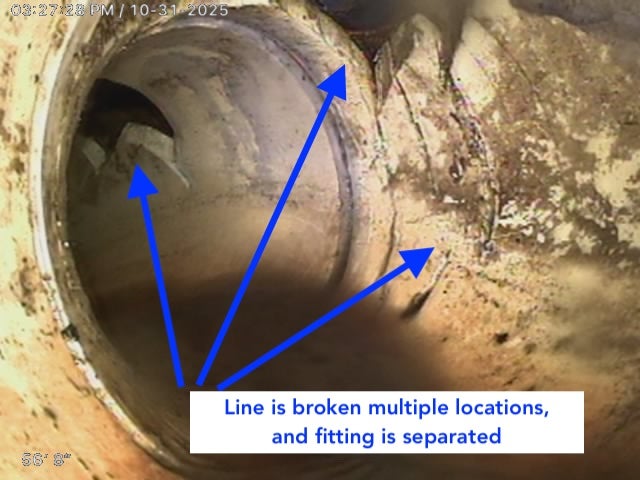
Subterranean soils are dynamic, subject to shifting from seismic activity, natural compaction, shifting water tables, and severe drought-to-deluge cycles common in North Texas. When the soil supporting a pipeline shifts unevenly, sections of the pipe can dislodge at the joints, creating structural "offsets." These sharp internal ridges catch debris as it flows downward. Furthermore, localized soil erosion or improper trench backfilling during original construction can cause a section of the pipe to sag, creating a hydraulic dip known as a "belly." In a sewer belly, gravity-fed water pools continuously, preventing the natural, self-scouring velocity of wastewater and causing heavy organic solids to settle, compact, and choke off the line.
3. Pipe Corrosion, Scale, and Tuberculation
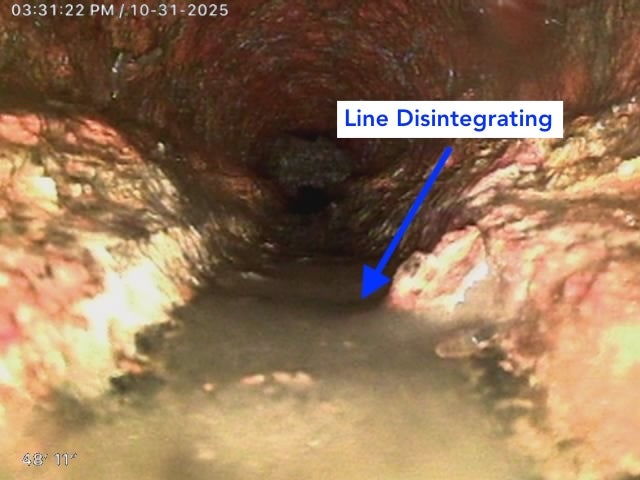
In residential homes built prior to the late 1980s, cast iron was the industry standard for waste lines. While robust, cast iron undergoes severe internal chemical degradation over decades of exposure to hydrogen sulfide gas and household chemicals. This leads to "tuberculation"—the formation of jagged, crusty mounds of rust and oxidized iron deposits inside the pipe interior. This rough topography catches solid materials, reduces the effective interior diameter of the line, and catches debris. In advanced stages, the bottom channel of a cast iron pipe can completely corrode away, leaving a floorless pipe where waste cuts a channel directly into the raw earth beneath the home's structural slab.
4. Cracking, Fractures, and Total Pipe Collapses
Severe external weight loads—such as driving heavy construction vehicles over unreinforced lawns, or structural shifting near deep foundations—can cause catastrophic physical fracturing of the sewer pipe. This is especially true for brittle materials like clay or vintage Orangeburg pipes (which are essentially compressed tar paper tubes prone to flattening into an oval shape over time). When a pipe completely collapses, the path to the municipal main is fully severed. Raw sewage escapes into the surrounding soil, creating structural voids, washing away foundational support dirt, and creating a critical health hazard on the property.
5. Debris Accumulation and Chemical Obstructions
A camera inspection often uncovers non-structural blockages that are equally problematic, such as thick blankets of hardened fats, oils, and grease (FOG). This happens when previous tenants repeatedly pour kitchen grease down the drain. Additionally, accumulation of flushable wipes, feminine hygiene products, or scale buildup can severely narrow the pipe’s clearance. Identifying these issues early allows the buyer to require a high-pressure hydro-jetting service before moving in
Financial Protection: Avoiding Post-Closing Disasters
The primary motivation for executing a pre-purchase sewer scope is financial risk mitigation. When a home buyer signs the final closing documents, they legally inherit all structural liabilities within the property boundaries. A common misconception is that the municipal utility company is responsible for the entire sewer network. In reality, the homeowner holds complete, exclusive financial accountability for the lateral sewer line from the house up to the exact point where it splices into the city main—even the portion that extends beneath public sidewalks, parking strips, and roadways.
Repairing a subterranean main is an exceptionally labor-intensive and costly enterprise. Traditional open-trench repair methods demand heavy excavation machinery to dig up lawns, destroy mature landscaping, tear through paved driveways, or jackhammer through interior concrete foundation slabs. If the failure occurs underneath a city street or municipal right-of-way, the homeowner must obtain specialized municipal permits, pay for traffic control detailing, and fund asphalt restoration, driving repair invoices upward instantly. Even trenchless rehabilitation technologies, such as Cured-In-Place Pipe (CIPP) lining or pipe bursting, require substantial upfront investment. Spending a modest fee on a diagnostic camera scope before purchasing is an incredibly high-yield insurance policy against a massive unforeseen expense immediately after moving in.
Gaining Critical Negotiation Leverage
In competitive real estate markets across Burleson and surrounding areas, purchase contracts are heavily contingent upon the findings of due diligence inspections. Uncovering a damaged sewer line via a camera scope completely shifts the power dynamic back into the buyer's hands during the option period. If an inspection documents a compromised line, the buyer has several highly effective, legally supported avenues of recourse:
- Demand Seller Repair: The buyer can formally request that the current owner hire a licensed commercial plumbing contractor to repair the structural defects or completely replace the line prior to the official closing date, backed by a clean secondary camera inspection.
- Securing Financial Credits: Buyers frequently prefer to control the quality of the repair work themselves. Armed with itemized, certified plumbing estimates generated from the sewer scope findings, the buyer can negotiate a substantial reduction in the home's purchase price or request a corresponding credit toward closing costs, ensuring funds are held in escrow explicitly for the plumbing remediation.
- Walking Away Unharmed: If the structural damage to the sewer main is catastrophic, or if the seller flatly refuses to concede financial accommodations, the documented sewer scope report provides the ironclad empirical evidence needed to void the contract under the inspection contingency. This allows the buyer to walk away with their earnest money deposit fully intact.
Property Profiles That Require Mandatory Inspections
While every single residential purchase warrants a sewer inspection, specific property profiles carry significantly elevated risk factors and should never be purchased without a comprehensive camera scope:
- Homes Constructed Prior to 1980: Properties built during these eras are highly likely to feature clay, cast iron, or Orangeburg systems that have reached or extended past their engineered lifespan.
- Mature Landscaping and Established Trees: If a property features large, mature oak, elm, or maple trees in the front yard anywhere near the projected path of the sewer line, root intrusion is practically guaranteed to some degree.
- Properties Unoccupied for Extended Periods: When a home sits vacant without active water flow, the interior of cast iron and galvanized pipes dries completely, accelerating internal oxidation, flaking, and structural scaling, making them highly susceptible to immediate failure once regular usage resumes.
- Flipped or Extensively Renovated Homes: Investors frequently focus their capital allocations strictly on high-visibility cosmetic enhancements to maximize short-term profit margins. They routinely ignore deep underground infrastructure. A home can feature beautiful, high-end design elements upstairs while harboring a completely deteriorated 60-year-old wastewater line below.
Conclusion: Protect Your Investment Before the Contingency Expires
The old adage "out of sight, out of mind" represents a uniquely dangerous mindset when investing in residential real estate. A home's sewer lateral is its primary metabolic highway—essential for health, sanitation, and daily operational habitability. Relying solely on a superficial cosmetic walkthrough while ignoring the subterranean drainage matrix is an unnecessary gamble.
By integrating a dedicated plumbing sewer scope inspection into your standardized real estate due diligence protocol in Burleson or surrounding North Texas towns, you replace assumptions with definitive, visual reality. Ultimately, this specialized plumbing evaluation provides invaluable peace of mind, verifying that your dream home rests on a structurally sound foundation from the ground up.